


Psyllium Husk
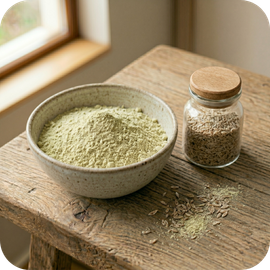
Psyllium husk is a natural source of fiber obtained from the seed coats of the Plantago ovata plant. Traditionally used to support dietary fiber intake, this ingredient is preferred in many modern food products due to its functional properties.
The primary reason we use psyllium in our formulation is its naturally high content of soluble fiber. Although pulses are already rich in fiber, the addition of psyllium helps further enhance the product's overall fiber profile.
The second, and equally important, reason is production technology. When psyllium comes into contact with water, it forms a gel-like structure. Thanks to this property, it helps the dough become more homogeneous before extrusion, binds the ingredients together during processing, and contributes to a more balanced texture in the final product. It is one of the key natural ingredients that support structural stability, especially in high-protein and pulse-based products.
In terms of flavor, it has a completely neutral profile. Therefore, it provides functional benefits without altering the product's characteristic pulse and spice aromas.
In short, we do not use psyllium husk merely to increase fiber content; rather, we use it to support the product's structure, ensure the ingredients work together harmoniously, and deliver a better consumer experience.
On average, 100 g of psyllium husk contains:
Energy
~180-220 kcal
Protein
~75–85 g
Carbohydrates
~60-70 g
Dietary Fiber
~2-5 g
Fat
~1 g'dan az
*Values may vary depending on the psyllium raw material used.
References
1- Guo, Q., Cui, S.W., Wang, Q., & Young, J.C. (2008). Fractionation and physicochemical characterization of psyllium gum. Carbohydrate Polymers, 73, 35–43.
2- Fradinho, P., Nunes, M.C., & Raymundo, A. (2015). Developing consumer acceptable biscuits enriched with Psyllium fibre. Journal of Food Science and Technology, 52, 4830–4840.
3- Fischer, M.H., Yu, N., Gray, G.R., Ralph, J., Anderson, L., & Marlett, J.A. (2004). The gel-forming polysaccharide of psyllium husk. Carbohydrate Research, 339, 2009–2017.