


Green Lentil Flour
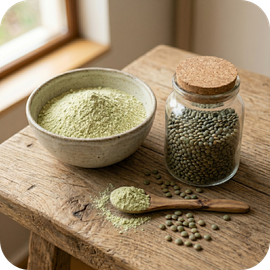
Although green lentil flour belongs to the same family as red lentils, it exhibits certain differences in terms of flavor, aroma, and nutritional profile. For this reason, instead of relying solely on red lentils in our formula, we prefer to combine different legumes.
While red lentils offer a milder and more neutral flavor, green lentils possess more distinct, slightly earthy, and characteristic legume notes. This difference prevents the product's flavor profile from being one-dimensional, making it richer and more balanced.
Nutrient-wise, both lentils naturally contain protein and fiber. However, using different legumes together helps increase not only the amount of protein and fiber but also the diversity of naturally occurring vitamins, minerals, and phytonutrients. Just as combining different vegetables in the kitchen provides a more diverse diet, different legumes support the nutritional diversity of our product.
From a production standpoint, green lentil flour works in synergy with other legume flours to contribute to the product's structure and strengthen its legume-based character.
In short, we use green lentil flour not just as a source of protein and fiber, but for its unique aroma that complements red lentils, the distinct nutrients it offers, and its ability to create a richer legume blend.
Nutritional Values (Per 100 g of table salt on average):
Energy
~340-360 kcal
Protein
~24-26 g
Carbohydrates
~55-60 g
Dietary Fiber
Fat
~1-2 g
*Values may vary depending on the variety, cultivation conditions, and milling method.
References
1- Boye, J., Zare, F., & Pletch, A. (2010). Pulse proteins: Processing, characterization, functional properties and applications in food and feed. Food Research International, 43, 414–431.
2- Thavarajah, D., Thavarajah, P., Sarker, A., & Vandenberg, A. (2009). Lentils as a whole food for increased iron and zinc intake. Journal of Agricultural and Food Chemistry, 57, 5413–5419.