


Dill
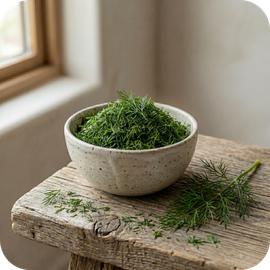
Dill is a herb with a light and refreshing aroma that is widely used in Turkish cuisine, from yogurt-based dishes to olive oil-based recipes. Just as it provides a sense of freshness when added to salads or yogurt at home, it creates the same lighter and more balanced aromatic layer in our product.
The main reason we use dill is to soften the strong and rich flavor profile of our legume-based product and provide a fresher herbal balance. While oregano and basil offer more pronounced aromatic characteristics, dill delivers a subtler, greener, and lighter flavor profile.
From a technological perspective, dill acts as a “delicate top-to-middle note” within the seasoning blend. In other words, it does not create a dominant flavor; instead, it softens and balances the stronger flavor profile created by the other herbs and spices. As a result, the product develops a flavor profile that is not only rich in aroma but also smooth and easy to enjoy.
Dill naturally contains volatile aromatic compounds such as carvone and limonene. These compounds give the herb its characteristic fresh, mildly citrus-like, and herbal aroma. For this reason, dill is widely used in products that aim to deliver a refreshing aromatic profile and support a pleasant sensory experience.
The aromatic profile of dill is primarily derived from volatile compounds such as carvone and limonene. These compounds provide the herb with its fresh, slightly sweet, and herbal aroma characteristics. Therefore, dill is widely used as an aromatic herb in both food products and traditional culinary applications.
We use dill not simply as a seasoning, but as a natural flavor-balancing ingredient that softens the rich legume and spice profile, making the product lighter and more suitable for everyday consumption.
Average nutritional values per 100 g of dill:
Energy
~300 - 310 kcal
Protein
~15–18 g
Carbohydrate
~54–57 g
Dietary Fiber
~20–22 g
Fat
~14–16 g
*Values may vary depending on the variety, cultivation conditions, and milling process.