


Bean Flour
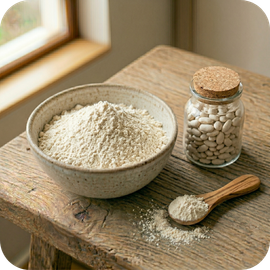
Bean flour is obtained by grinding beans, which hold an important place in many cuisines around the world. It is one of the valuable members of the legume family, just like red lentils, green lentils, and chickpeas. The reason we include bean flour in our formulation is to bring together the strengths of different legumes instead of relying on a single type of legume.
From a taste perspective, beans provide fuller and more characteristic legume notes compared to lentils and chickpeas. At the levels used, it does not create a dominant taste; instead, it works together with other legumes, increasing the flavor depth of the product and creating a richer aroma profile.
In short, we use bean flour not only as a source of protein and fiber, but also to increase the diversity provided by different legumes, to create a richer flavor profile, and to strengthen the legume-based structure of our product.
Average nutritional values per 100g of bean flour:
Energy
~330-360 kcal
Protein
~20-25 g
Carbohydrate
~55-60 g
Dietary Fiber
~15-25 g
Fat
~1-2 g
*Values may vary depending on the variety, growing conditions, and milling method.
References
1- Boye, J., Zare, F., & Pletch, A. (2010). Pulse proteins: Processing, characterization and applications in food systems. Food Research International, 43, 414–431.
2- Campos-Vega, R., Loarca-Piña, G., & Oomah, B.D. (2010). Minor components of pulses and their potential impact on human health. Food Research International, 43, 461–482.